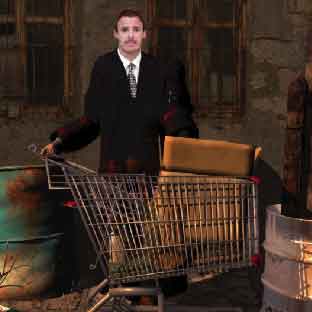
Should we, as a nation, feel responsible for a single person who is homeless?
If homelessness is a normal feature of life do we really need to be bothered
by this phenomenon? If it is a state of being — such as the natural balance
that gets established at the end of a long race — we certainly do not need
to fear homelessness; it can then be seen as a natural occurrence. Is it not
true that in nature the number of trees, plants and animals are the numerical
result of an intrinsic and complex natural balance? Some species die off when
new species invade their territory, who eat the same food as the native species.
Some native species may not die off, but they nevertheless experience a diminishment
of options due to the new balance. We could state that the natural balance is
the most essential feature of life on earth. Can anyone argue why this should
not be applied to humans? Summary The more CEOs make the more homeless in a nation. The economic premise is that
the housing market as a whole will build homes for those who can afford it and
not for those who can't. When the top layer in society is increasingly rewarded
— receives an increasingly larger percentage of all moneys in society —
the pull on the housing market to build for that group gets stronger and this
prevents building for the whole of society. The report by John M. Quigley et
all [Homeless in America, homeless in California, The Review
of Economics and Statistics, University of Berkeley, February 2000. 83(1): 37-51]
contains data that supports the idea that a slanted economic balance delivers
a slanted outcome. The United States has the largest percentage of homeless
people of all rich nations in the world, American CEOs also take home a truly
much larger share of the cake than anywhere else in the developed nations. The
housing market does not function properly for all people anymore. Most people
agree about this aspect, but the importance of the natural balance — where
the CEO's income is linked to the amount of homeless in a nation — receives
hardly any attention. The Homeless CEO What is the natural balance for housing? What are the natural balances that
exist in our economy. Just like in nature economic balances are being established
by all kinds of features. We all know that supply and demand are important features
of the economic balance; they help create the outcome in general. If there is
a certain amount of food in the park then only so many animals can live off
of that all year round. Another important feature is scarcity. With scarcity
goods and services obtain an extra value that is not in place for goods that
are ubiquitous. With scarcity the balance gets moved to a higher position because
higher prices are created when there is more demand than supply. When invading
species start eating your food, that food obtains a lot more value all of a
sudden; it may even become worth fighting for. As one would expect, home owners
and investors like some scarcity. With scarcity home ownership and investments
are more secure. To aid others and have the scarcity be totally gone is not
in any owner's best self-interest. If nobody needs the house you are selling,
the price may drop significantly. Another feature of the balance is that a real
need does not necessarily have to exist throughout, because a perceived need
would already be sufficient. The idea that one should own their own house can
be promoted, by commercials run on television, by culturally established perceptions,
or with special tax incentives delivered to you by your government. The supported
'need' adds to the demand side of the housing market. It is a fact
that the current housing supply gets augmented daily with new housing. The home
builders do build for a market that wants even more. But with a shortage of
supply, who do the home builders especially want to build for? One simple answer
applies here: the best of the market. If you can build for a larger margin of
profit, wouldn't you? Your competitors most certainly will. An important aspect
of the housing market appears to coincide with another natural balance: the
balance of income as it exists in our nation. Some people make minimum wages,
others earn a salary, while others have their ships come in. Have you ever cared
about the balance of incomes? Did you ever stand up and said that CEOs make
too much? With possibly the only exception being former Stock Exchange chief
Grasso the natural balance of income in the United States
is not really counterweighted by anybody questioning the wisdom of ever increasing
salaries for the nation's top CEO's. It may be prudent to understand that it
is not just the CEO — the CEO is the metaphor for ever increasing levels
of income for decreasing amounts of people. As a group, the people with high(er)
incomes happen to be the segment in the housing market that is most profitable
for the home builders. This
is possibly the most important feature of the income balance for the housing
market: if the financial balance is slanted in a nation, the building market
is slanted too. The more the CEO makes, the less the building market will build
for an increasing group of others with less income.
In nature, weather and climate influence the natural balance. Animal behavior can change the balance too, for instance, when birds help propagate especially the seeds of the berries that they like, by eating the berries and then dropping the seeds in their fertile droppings. Can human beings influence the natural balance? In the Sea of Japan fishermen noticed how the fish they were catching had grown smaller over the last thirty years. Was this a freak occurrence of nature? In these thirty years fishing techniques had improved a lot, but the age old tradition was still honored to throw back any fish that was not mature yet; they were to be caught only when they had grown bigger. During these centuries the fishermen had not tinkered with the overall outcome. Yet with the new fishing techniques so many fish got fished that the behavior to throw the small fish back into the water influenced the result: the mature fish that were small in size were thrown back and now took center stage in the gene pool of the population. The larger fish were processed, but the mature but small fish survived. A few years ago the Japanese fishermen changed their behavior when they realized that they were the ones who had changed the balance. Now they also throw back some of the largest fish, and hope that in the future, the average size of their fish will be 'normal' again.
This example shows that how we approach the natural phenomenon of catching fish changes the long term outcome. The specific attitude is far more important than it appears on first sight because it has long term implications. It is impossible not to similarly influence the natural balance of human society. How do we approach the overall economy? Which 'fish' are caught? Which 'fish' are thrown back? A simple daily example, like that of your bank charging a fee or not is already a good indicator. The bank charges you a monthly fee when you only have a little amount in your bank account, but that same bank does not charge a fee for bank accounts with large amounts of money. The benefit of getting your money is penalized if it is not enough. The government does something similar. Tax breaks are not given to people with a tiny income; the number of tax breaks increases when you have more money (and thus opportunities to make use of the tax breaks). The how is not set in stone; it is different in most nations. The American how is in general that the more you have the larger the benefits are that you can receive. American behavior is to throw back especially the largest of fish. That will lead to larger (read: successful) offspring as well compared to other nations. Fish that can quickly grow larger is genetically promoted. The chances for the small fish to survive are depressed by, first, catching small fish in the nets and processing them for consumption and, second, by moving out the mature smaller fish of the gene pool. The immature fish and the smaller mature fish end up being canned. Naturally, people are not being eaten; they are simply left to their own devices. The how in other nations clearly delivers a more equal chance for a housed existence, not just in Cuba, but in most European nations, Canada, and Australia. The homeless people exist here in larger quantities than elsewhere because of the American how.
The CEOs who are benefiting the most will replicate faster than the average person in our nation. The CEO's do not necessarily replicate by offspring, but most certainly by example. Other people seeing their example will probably want the same. Other CEO's will start demanding the amounts of money required to buy one of those McMansions their friends and co-CEO's already have. And with them taking more of the financial cake, they are the ones who will also use up more of the available land that is around. A larger percentage of the money goes to fewer people, and more of the land that can still be developed goes to fewer people. When available land and money remain the same, the others in society must do with less money, and do with less land.
In a forest, the food eaten by the larger invading species becomes less available for the other species, and the first ones to fall off the wagon are the ones who were somewhat holding on by a thread already. The importance of the remaining food increases dramatically for all species. It is not the center part of the balance that gets impacted first. The center of the balance is generally insulated from the most severe impacts, while the outer sections show the most swing. The more weight on one side, the sooner the other side will be hanging in the air. The increasing incomes of the CEO's impact directly the amount of homeless. The ones who were hanging on for dear life, are the first to fly off of the swing.
Can we find evidence to support this natural phenomenon. In nations with more balanced levels of income, the housing builders are providing exactly the same way as here: for the market, but homelessness is not a big problem there. The markets over there crank out less McMansions, and a lot more affordable ordinary places. The housing builders still make a good profit because they are actually in balance with their competitors who build for the same market. With CEO's not eating up all the money, more money stays in the hands of others, and almost all people can afford to live in the apartments and flats. Of all rich nations in this world, the income balance of the United States is most slanted, and it is here that the housing market provides especially for the ones with more money. Of all the rich nations in the world homelessness is the highest in the United States. Is the conclusion justified that the richer the CEO is, the more homelessness there exists in a country? Is one phenomenon linked to the other? Indeed, the report by John M. Quigley et all [Homeless in America, homeless in California, The Review of Economics and Statistics, University of Berkeley, February 2000. 83(1): 37-51] shows data that supports this idea. From this data the conclusion is clearly distilled that "homelessness increases with the degree of income inequality."
We are not heartless people. In general, homelessness is seen as a problem in the United States. People sympathize with the homeless. The homeless could be us. We could be them. Nevertheless, we seem to have problems opening up our eyes to see that the large amount of homelessness is created by an income imbalance and not by personal failure by the homeless themselves. Hanging on for dear life and then letting go of the swing can be contributed more to the heavy weight on the other side than to the precise action of letting go by the homeless. It is sometimes difficult to look beyond our perceived ideas — confirmed through many conversations — but not established by all the facts. As Americans, we believe we can get out of our troubles by working hard — and when needed even harder. We believe that the market works, and in this belief we tend to forget that the facts are not only stacked against the homeless, but because of the established belief we actively support an ever increasing imbalance. Politicians tend to deliver more and more regressive taxation plans. And nobody opens up their mouths when the CEO makes yet again a tiny bit more money. There are examples that the market does work, but these examples do not mean that the market works for all.
Let's find an economic situation in which there is no perceived problem to have the economic balance be whatever it is. When airline carriers compete with each other, those who want to fly will be pleased with the fact that several companies are out there competing for our dollars. We are happy with the competition when looking for a good deal on an airline ticket. We do not perceive the fact that some people do not have the money to fly as a problem. Goods and services, like the ones the airline industry provides, can get established — as is — and the natural balance occurs without anybody having to feel disheartened. It is almost like a stream in nature where animals come to quench their thirst. When the lions are drinking, the wildebeests will wait till they are gone. If they can't get to the stream? They may move further along the stream and find water there.
If you can't fly in the summer, you may be able to fly in November when the prices are low. Are there any people out there who would like to fly but cannot afford to fly? Of course, but we can hardly call this a problem. The natural balance in the airline industry can go in whichever direction and not too many people (except those employed by the particular airlines) care about the fact that airlines come and go or that some people cannot afford to fly. When there is a good amount of profit in the airline industry new airline companies can come in and spoil the fun. This establishes a new balance. The airlines will all start to compete harder; especially for the most profitable destinations and as a result they sometimes must abandon those destinations where not too much profit exists. Because of the competition, some destinations now have fewer airline companies going there, while some destinations have more airline carriers going there. If more people live in an area, more air carrier choices will be available to them. If you live in a less populated area, your choice will diminish and what is available will be relatively expensive. There is in general no problem in the airline business where balances are established and reestablished, though some areas will end up having fewer and more expensive options. It is different when the exact same principles come into play with housing.
In the airline industry we do not think that there is a problem with the "flightless." But the homeless áre considered a problem. In both economic balances there is a group that cannot purchase the product. Because people are affected more profoundly by being homeless, the established balance is not satisfactorily, and therefore we call it a problem. Without a problem, the airline industry will specialize to deliver their products to the best paying segments. The more CEO's fly the larger the business segment on the plane will be, or a new category with even more service will be created. One of the possibilities is that the price for the seats in the business class will actually come down, while the price for the fewer seats in the economy class may very well move up. The market will be geared — must be geared to survive in a very competitive area — to the people flying business class. The industry will sooner rather than later reflect the natural economic balance.
It is easier to add an extra plane with a lot of capacity in the airline industry than it is to add a suburb with a lot of capacity to a city. So, the economy of scales of putting a new plane in service keeps on working for the economy class flyers — the airline industries keep making interesting amounts of money on new investments for this segment because it is relatively easy to do — while in the building industry the lack of new land has come into play more prominently. The newly developed locations are further and further away from the centers. Not everyone is able or interested to drive this much — unless the house and its environment are really worth it. The bigger income for the CEO enables this group of people to use up the new land faster.
The builders have to work harder per individual buyer — who wants a much larger house than the average person — but the financial reward is simply wonderful. A win-win situation exists for the builder and the new home owner. A larger house in an excellent environment and a profit that truly satisfies the builder. The ones losing out are not mentioned here. They are not included in this picture. From the perspective of social responsibility, it is good to understand — concluded from this data — that the suppliers do not have a personal issue with providing housing to some but not to the other. It is simply a matter of the natural economic balance.
Homelessness is not a problem that can be solved by any natural economic actions or policies just concerning the housing market. Let's admit it: homelessness is not an economic housing problem. The economy is functioning just as it should; the balance is exactly what we should expect under these circumstances; the building industry is only making the profits to keep their industry healthy, they are not making exorbitant amounts of money. Homelessness is only an economic result that we consider to be a social problem. Homelessness is the result of ordinary economic starting points and — subsequently — to find solutions to this problem we need implementations of the correct socioeconomic and political policies. Otherwise we have accepted that homelessness is not going to go away. Today you and I have accepted the natural balance that exists in the housing market; we have accepted the slanted balance of income that exists in the United States.
Why is there more homelessness in the United States than in any of the other rich countries in our world? The income gap between the top 20% and the bottom 20% of this society does not have its equal in the developed world. As a striking example, a study performed by TowersPerrin [BusinessWeek, Spreading the Yankee Way of Pay, April 18, 2001] shows how top CEOs of the largest publicly traded companies are being paid differently depending on the country of the company. CEOs of these American companies received 531 times the salary of the average hourly worker. The highest paid European CEOs (in Britain) were paid 25 times the salary of the average hourly worker. In the United States, the supply side of the housing market receives a very impressive extra tug into the direction of the top salaries. Satisfaction for the housing market supply side is achieved before society as a whole is satisfied, while the McMansions aggravate the situation by eating up the available space around the cities. They become the example of success for society as a whole, and the focus is that others will try to emulate this behavior. The focus is not on the trail of the destitute that goes hand in hand with the economic imbalance.
The more the CEO makes, the more people are made homeless. It is not the exact amount of money the CEO makes that creates the phenomenon of homelessness; it is the ratio of income that creates the existence of homelessness. If the CEO makes 10 million dollars, and the lowest paid clerk makes $100,000 there would be no homelessness. The ratio is one of the most important parts of the economic balance. The larger the ratio, the more the market ends up functioning for one side (the higher end) and not for the other.
Professor Gary S. Becker, University of Chicago, USA, who received a Nobel prize for his outstanding work in the economic field may have hit the right spot when showing that the economically disadvantaged benefit most from an open economy in which competition is not restricted. This seem to support the much touted idea of laissez-faire. Let's investigate this a tiny bit. Laissez-faire is squarely based on freedom. Is there freedom of location? Where are all the jobs located? Is there enough land to deliver sufficient housing? It is imperative to understand that, as soon as the issue of an open economy is addressed in the same sentence as a social issue — like homelessness — it should be acknowledged that the playing field of freedom is no longer restricted to just that of economics. Freedom isn't just economic freedom. Freedom is spatial freedom to have the market build houses in the area of need. Freedom is the right to sit at the table — or at least have a representative sit at the table of the decision makers. With only people at the margin falling off the table, the remainder at the table keeps on ignoring this phenomenon. It has been said many times that only when the middle class is affected by the same phenomenon as the poor will society move toward fixing the ugly mechanisms.
To agree with professor Becker, all structures that exist in our society must be considered in his premise, because all structures have socioeconomic consequences and deliver freedom to specific parts of society. Boundaries of nations, for instance, do not really exist in nature, yet as soon as they are established they come into play economically. The value of the dollar fluctuates — sometimes dramatically — against other currencies. The people trading in these values experience enormous changes, while most people in the streets of these nations actually notice nothing or only a small fraction of change. The dollar and the euro fluctuate enormously once every twenty years, while the prices in the stores — here and there — do not budge much. Nations have different playing fields: some nations provide better education, some nations take better care of all who live within their borders, some nations do not have high taxes because they provide hardly any services in order to be most competitive, some nations have the strictest of rules. Some nations deliver a slanted balance in income. If we were to follow Becker's ideas, each nation in the world should sign as many international treaties as possible because the more international treaties there are the less obstacles — and thus more freedom — the economic forces will encounter. One could state that the WTO is the best thing that could happen to the homeless all over the world, because economic regulations are basically being transformed to fit a single freedom-loving playing field. While in theory this may be true, this image is missing some vital input of freedom. Social problems are not being addressed by the WTO. People with socioeconomic problems, like the homeless, do not have any power in the WTO. The economic urge to support a higher placed balance (supply and demand augmented by scarcity, tax incentives, and perceived needs) is not countered by the social urge to maintain a balance that provides the best outcome for our most desired needs (by establishing reasonable minimum wages that diminish the income ratio).
By creating an all powerful WTO without a social context, the ideal of laissez-faire — that the economy will deliver all solutions if we just let it do its thing — has become the inconsiderate ideal for the world. There is no world union that has the power and the will to have everyone go on strike at the same day to demand higher wages for those in our world with the least pay. There are no negotiators around the WTO table to demand a higher world standard for minimum wages. There are no negotiators who demand a fixed maximum ratio between top salaries and minimum wages. The economic balance is not countered to supply housing for all of us — it remains balanced to satisfy the supply side and the ones who stand taller in the labor market. That's not freedom.
If professor Becker is correct that the disadvantaged stand to gain the most in unrestricted economies, then all political structures should be converted to the Northern European version of democracy where people vote for — and get — their own representatives. Any other political format restricts the freedom of voters and creates a diminishment in economic stability and equality. The US system, for instance, has people vote for winners of districts. Close to half of the voters who voted for the loser in the race may end up without a representative. The larger the district the more money the candidates must have to even start competing, therefore the winners of House and Senate seats are either wealthy themselves or well-connected to influential third parties. American democracy contains major restrictions that are visible in the outcome. For instance, the United States occupies a rather low position when looking at the percentage of elected female representatives in the world. Our American elected representatives are therefore not as representative of us as representatives in other developed nations are of their population. Professor Becker professes an economic utopia that hopefully will exist in the United States one day, but that does not exist today. Only two versions of main stream America have ever gotten a democratic outlet in the past fifty years. By design, there are no representatives in Congress representing the three million homeless — none. The bottom side of this nation is unable to establish an individual political party for itself that can stand up for its needs, even when all homeless people would cast their votes nothing would change; the agenda of the homeless gets adjusted and adjusted again by the mainstream wishes of the two party system, which happen to consist of people who already have a home. For them, housing is not a priority. It is a sociopolitical tragedy. The freedom of representation should not be a freedom only in name; it should be a right that is guarded in the outcome.
Other economic realities that restrict freedom come into place as well, like the phenomenon of acquiring a patent. Acquiring a patent creates an enormous incentive to find something nobody else has found so far, claim it as your own, and prohibit others to use it unless the price is right. Patenting has major consequences for the money flow because patents tend to be concentrated not with society as a whole but with particular — often urban — highly educated individuals. Exclusion is the hallmark of patenting. It establishes a natural balance and — truly — there is nothing wrong with patenting, but it can be harmful unless society as a whole is willing to carry the specific burdens patents create. Professor Becker may have hit the nail right on that freedom is the best way to achieve a better life for all, but the surface to nail that nail in appears to be made out of steel — not wood. The context in which the homeless exist does not deliver freedom to the homeless at all. The freedom to improve one's economic standing plays out better on the side of the CEO in getting more and more of the cake.
As mentioned before, the economic ratios of income in Europe are much better. National governments actively address the economic imbalances: minimum wages are more in sink with the cost of housing; housing restrictions are sometimes put in place where people with higher incomes are not allowed to rent houses significantly below their means. For example, if you make 50,000 Euro a year, you are not allowed to start renting a place that is on the market for less than 500 Euros a month (you will not be kicked out of your house if you start to earn more later). Plots of land múst deliver a minimum amount of homes. If we would look both at the homeless in San Francisco and at the Housing Distress of San Francisco, we would find two very different numbers. The Bay Area as a whole is in need of housing far greater than what can be expected when glancing over the numbers of homeless in the Bay Area. The enormous pressure that exists throughout the United States to live close to this economically viable place is an economic reality that also creates an ever deepening inequality in income, which leads again to further homelessness. A greater amount of the monthly income is used to pay your rent or mortgage in the Bay Area than in most other places, because those with the higher incomes outbid the ones with the lower incomes. Scarcity drives up the rent. Imagine the amount of people that would like to come to the Bay Area to improve their current situation but who are held back by the threshold placed in front of them in the form of high prices for housing.
We can talk about hunger, and we can talk about starvation. Starvation is definitively more poignant than hunger, but by addressing starvation — and not hunger — we leave the potential of starvation out of the picture. The natural balance is better served when we address hunger in general. Similarly the housing distress is a far better indicator of what is going on than the problem of homelessness. Vince Hoenigman [Homelessness in a Progressive City PDF - Recommendations of SPUR's Homeless Task Force, San Francisco, 2002] appears to deliver the most encompassing measures to defeat homelessness. However, the ideal that society accepts the homeless as their own problem is contrary to the political tide. While delivering many excellent examples on how to improve the problem of homelessness, any improvement in San Francisco alone will result in a greater influx of people in need of such aid. An enormous amount of people in the United States would love to live and work here — are ready to improve their current situation. One bucket of water in the desert will attract a lot more than the one bucket can provide for. It is the nation as a whole where the economic balance is under duress; one cannot solve that problem in only one location. On has to do that together.
Homelessness is the national result of a national problem. Less jobs are available in the Midwest, more work is available in San Francisco, but more of your income is used towards housing in San Francisco. While those who used to live in single-room occupancy (SRO) units could still afford these places in the seventies, the availability of SROs has diminished sharply due to societal imbalances. More money could be made by converting these units into economically more viable locations in San Francisco. From my economy classes I learned about the phenomenon of the economic wave. While some economic areas rise — sometimes tremendously — other areas simultaneously fall. Just like a wave running towards the coast, the area that is right in front of the wave is actually being depressed by the pulling forces of the oncoming wave. The wave attracts water from the front, pulling the level of the water down, while the push from the back delivers the higher crescent. Naturally, the overall level of the entire ocean did not really change that much. And we all know that.
Waves create steep depressions only in front of them. We see the same phenomenon in cities where the Central Business District is like the crust of the wave with very expensive ground prices, but where the surrounding areas have mainly cheap ground prices. People do not want to live in the shadow of the big buildings. People do not like the highways and other infrastructure that are created to maintain that CBD. People do not like the noise and busy-ness around them all of the time. It is the area where people with little income — starters, immigrants, minorities — may have their first and last toehold in the area. If another wave comes around — spilling another round of highly specialized interests over the edge of the current CBD — more affordable SROs may get converted into uses that deliver more income and profit to the owners, while no new accommodations are build for the ones no longer served. If their wages (and aid) are not improving, the alternative is as large as the number of streets in the city.
Initially, economic waves are not visible. The seas and the oceans are large bodies of water and the waves run through them without much visible effect. As soon as the wave reaches land (that is: bumps into a restriction) the wave will start to appear above water level, while depressing the water area in front. Though some people will magnificently ride the waves at its high, others are being depressed — or pulled under — by the oncoming waves. It is the nature of things. To get rid of homelessness either all restrictions should be thrown away to diminish the most dramatic waves, or the level of water (money) should be limited that can be pulled away from people. If there are no conditions for waves to appear nobody will be taken under by their force. Yet if the waves exist, basic standards can help people keep their heads above water. Basic standards, not based on a small sample of the actual situation (that includes the wave and the depressed area) but taken from the entire ocean, can be put in place (like meaningful minimum wages). Waves happen. In general, nobody can (or wants to) stop them. But the social problems created by the waves can be counterbalanced. When supported by the entire ocean, there is no real measurable economic advantage or disadvantage to implement basic standards.
Without a question, the social problem of homelessness becomes most obvious when we view it in the light of those who can definitively not be held responsible for the situation they are in. Though parents are not relieved from taking responsibility, society as a whole cannot be relieved from the responsibility towards its children either. As firmly established: homelessness is not created by the economic disability of just the parents. When society as a whole is only willing to build the economy-driven most profitable zenith of ten houses — while there are eleven families — one family will live outside in the streets (or two families live together in very close quarters). If the political structures do not give power to the bottom side of society, the wages in this society will be below the actual requirements for building/maintaining an eleventh house. The economic results are not just determined by the economic process; they belong to the wider context of our economic, social, and political willingness to organize ourselves. We as a society are responsible for — can actively change — the problem of homelessness. And it doesn't really affect the economy we are in. It is interesting that the "welfare-to-work" measures that were passed in 1996 [described by Conroy: Predicting the Effects on Changes in Welfare Payments on the Probability of Receiving Alternative Sources of Income: The Case of Homeless Persons in Los Angeles, Contemporary Economic Policy, July 2001. 19(3): 299-312] are squarely based on the assumption that the United States as an economic entity can function just fine for all. And in theory I agree, but I do not agree on where to put the blame when it goes wrong. The current idea is that the economy is part and parcel of the solution; in this culture one is almost not allowed to see it as part of the problem. Our nation is one-eye blind; it sees an image but it does not have a clear understanding of depth.
People in the United States believe that 'scarcity' is not an essential feature of economics; otherwise the "welfare-to-work" measures could not have had any societal support. These reforms are based on the idea that by taking away peoples' cash welfare at one point in time this will help the poor and homeless get sufficiently paying jobs. It is true, those homeless persons who are better prepared, better educated, and better connected than the other homeless may very well move into a paying job by this incentive. A homeless person may be pulled into a home to help pay for the mortgage or rent. A smaller amount of homeless people will indeed be the result — Hooray, the action appear to have worked. — but the Housing Distress has not diminished. The starvation is less, but the hunger is just as large. Often, the new jobs are still not paying sufficiently. These new workers actually help depress the wages by moving into the job market. Naturally, the supply side is very happy with that because they can then hire (extra) people for the lowest possible wages. The natural balance gets established — no matter what. There is definitively an upside to the measure, and there is also a downside; overall the global economy did not earn a single dime because of the move, and if the economic balance moved it only moved towards the ones who could benefit most of the action.
Other results of the "welfare-to-work" measures can also not be other than disastrous. Those without anywhere to go will be moved deeper into panhandling, peddling, prostitution, dealing drugs, and hard core crime. Societal cost may actually be much higher than the money not spend on those in need. Unfortunately, this is exactly the natural outcome for a nation with a two party system; when the largest possible majority is taken care of, the American political and economic functions stop. The generally accepted idea is that if it worked for those in power — and for those able to collectively voice their opinions — that it should work for all the others. A painful result, however, of the "welfare-to-work" measures was the preliminary result for children who do not have any parents taking care of them. There appeared to be a significant increase of children without any parents at all since the "welfare-to-work" measures were implemented. Those who are least responsible — the children — carry the largest burden. On the bottom side of American society a slip further towards the state of Brazil seems to be happening for children.
Another interesting — though devastating — look into how the approach to help the homelessness is working can be abstracted from the work by Dirk W. Early [The Role of Subsidized Housing in Reducing Homelessness: An Empirical Investigation Using Macro-Data, Journal of Policy Analysis and Management, 1998. 17(4): 687-696]. While most people agree that subsidizing housing would diminish homelessness, Early uses the data of Tucker [1987, 1989] and Quigley [1990] to show that the subsidies are not effective enough to have the homeless get into a house. At the bottom of the housing market many households hold on for dear life and use up the budgeted subsidies before it even gets to creating housing for the homeless. Early continues to conclude that expansion of the subsidies must be significant before the effects can be felt by the homeless. Again, the conclusion can be made that the need for affordable housing in the United States is far greater than any figure on the magnitude of homelessness is able to show. Only with a truly substantial amount of help, or with implementation of better labor standards (both are politically not feasible in the current United States) can any significant conclusion be drawn about the effectiveness of subsidizing housing.
When you fall asleep tonight, it may be good to wonder if you did enough for those who do not sleep well tonight. Sometimes it may help to demand more housing, and sometimes it may help to demand a more normal pay for CEOs. The ever increasing benefits for CEOs are the cause of an imbalanced housing market, which makes homelessness happen. Next time you hear someone brag about the enormous salary (s)he makes or a friend makes, think about the homeless, the slanted economy, and how we all contribute to the result. There is no more money in this nation, it only got moved more into the hands of the CEOs. It may be daring to voice your 'opinion' in front of your boss, but if you want to help, start speaking up about the devastating effect the high ratio of income has on this nation. If the CEOs didn't make this much, the market would work much better for all, and — concluded from data of more balanced nations — there would be no real problem of homelessness anymore in our nation.
Other links and sources